
Flubber and flow

2025-10-30T13:24:42-06:00
10/2025
Supporting Image
Supporting Image
Modeling glaciers
by Justin Burton, Alex Vargas

Glaciers have shaped the face of our planet for millennia, developing over hundreds and thousands of years as layers of snow compress into solid ice. Or IS it . . . ? Click to learn how glaciers actually flow like a liquid, and how the surprisingly similar physics of Flubber can build our intuition for how real glaciers behave.

0 0    
Flubber and flow2025-10-30T13:24:42-06:00

Polymers at Play: Make your own Silly Putty!

2025-10-30T13:25:04-06:00
08/2025
Supporting Image
Supporting Image
Silly Putty, serious science

There is some serious science behind Silly Putty! This classic toy gets its unique properties from materials you can find around your house or at the grocery store. Click to learn how you can make your own Silly Putty at home and try some fun experiments to investigate its properties!

0 0    
Polymers at Play: Make your own Silly Putty!2025-10-30T13:25:04-06:00

Ketchup and oobleck and slime, oh my!

2024-11-07T14:30:27-06:00
11/2024
Kids, like many of us, love playing with non-Newtonian fluids. Photo by tookapic/Pixabay.
What is a Non-Newtonian Fluid?

Why do so many fluids behave counterintuitively? Many substances in our lives – like oobleck, slime, or Silly Putty – don’t quite behave the way we expect a fluid to, despite some fluid-like properties. These substances fall into a special category: non-Newtonian fluids. Scientifically, this term is a bit of a catch-all for any substances that have a complicated relationship between their apparent viscosity and the force applied to them.

0 0    
Ketchup and oobleck and slime, oh my!2024-11-07T14:30:27-06:00

Plot Twist! The Science of Oreology

2023-07-20T13:45:16-06:00
04/2023
Supporting Image
Supporting Image
Fluids and filling

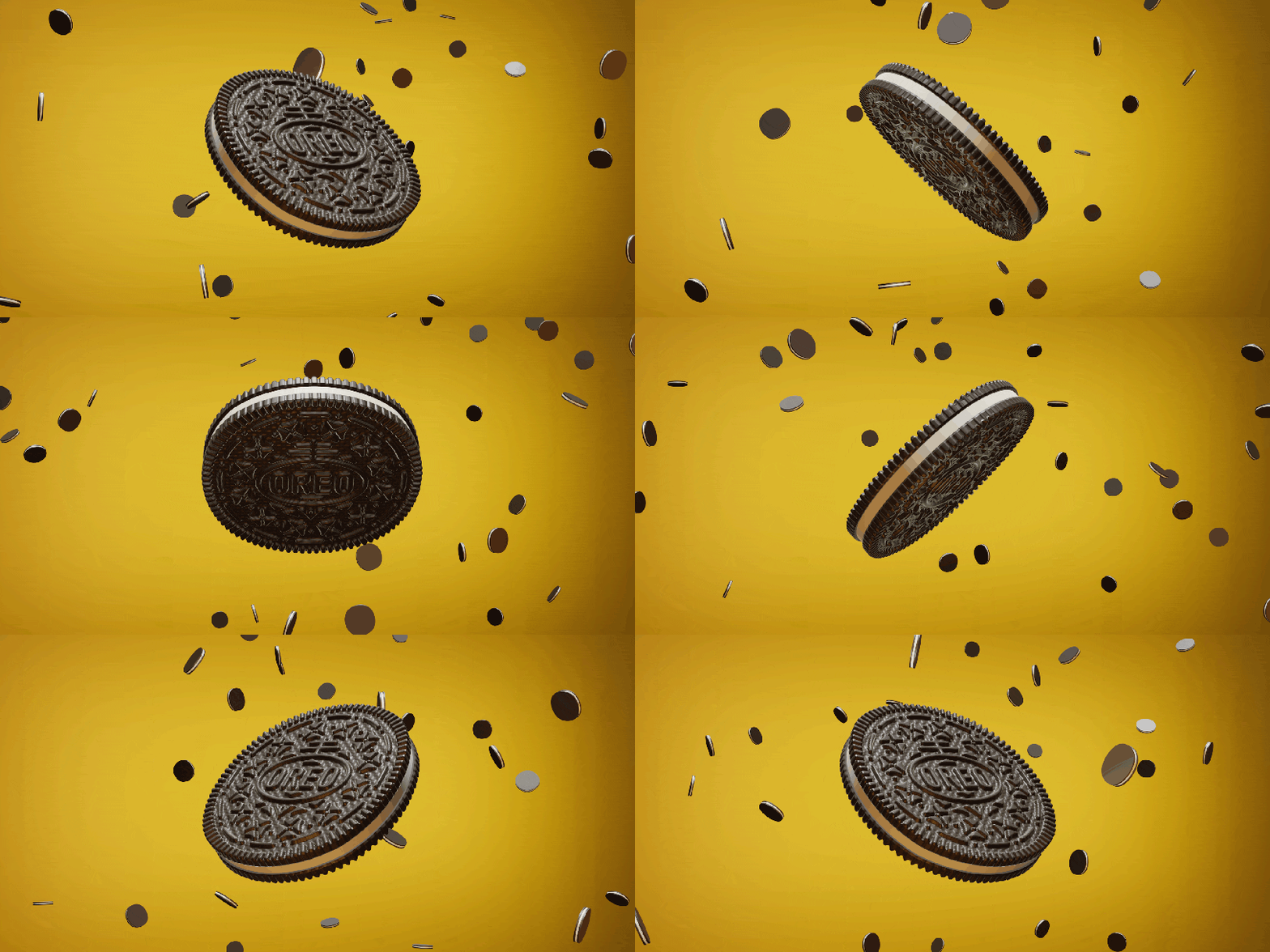
You take a pristine-looking Oreo from a package of seemingly identical sandwich cookies, and you decide to open it up to eat the creme filling first. You gently twist the cookie apart without breaking the chocolate wafers, but the creme sticks to one side only. Why? Happily, the physics of fluids helped two MIT students solve this delicious mystery. Read on to find out what they learned, and how you can test their results at home.


0 0    
Plot Twist! The Science of Oreology2023-07-20T13:45:16-06:00
Go to Top